
Simultaneously Creating Versatility and Consistent Branding in Controls
How can an OEM give customers more control options and flexibility while simultaneously maintaining a consistent branding standard across the board? In this article, we’ll take a closer look at this objective through pendant and radio remote controls and how both goals can be achieved through a few design and programming elements.
Flexible Control Design
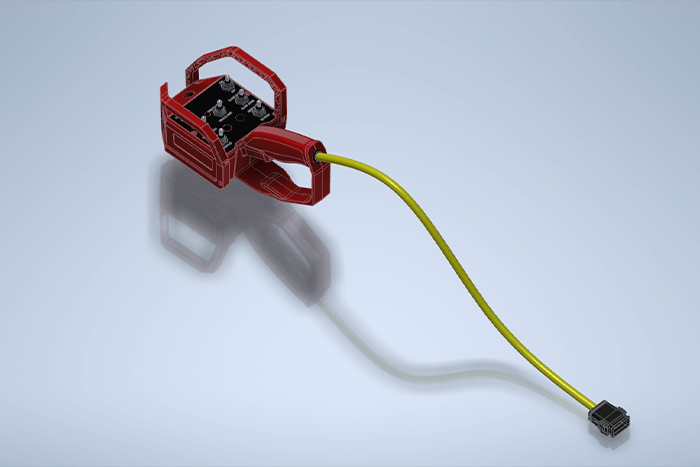
The most obvious way to customize a pendant is through the control design. Almost any combination of push buttons, toggle switches, and safety features, like e-stop functions, can be utilized in a pendant control. LED machine status indicators can even be integrated so that an operator is fully aware of other relevant functions. And while you can only fit so many controls on its face, in certain housings, such as the pistol grip pendant pictured above, you can also utilize flush push buttons on the sides.
How a pendant’s tether is set up is another decision that will have a bigger impact on operator experience. A tether can either be located at the top or bottom of the control, depending on OEM preference, but the internal wiring is another variable. Traditional hard wiring works for a standard pendant with one connection location. However, electing to use a CAN module will give the operator much more flexibility. Then an operator can simply plug the pendant into different locations on a machine. This method essentially gives OEMs multiple effective options across different control groups.
Creating a Uniform Product Family Brand
Even with all of that design flexibility, a few consistent factors can be enough to maintain a uniform appearance across your brand. Consistent branding across multiple product lines is a great way to increase brand awareness and visibility for OEMs. But that can be a challenge while simultaneously trying to provide a diverse product offering for your customers. The best way to accomplish this is to create a single solution using the same housing with the same symbols and decals across multiple product categories, from a more cost-effective tethered pendant to a more advanced wireless remote control. This allows you to offer the same look for multiple products at different price points. For example, maintaining the pistol grip design for both a pendant, pictured above, and a remote control creates two very different product offerings with a very similar appearance.
Cultivating significant brand recognition not only helps keep an OEM top of mind for customers, but it can have a real impact on sales. And creating a uniform look across multiple product categories, not only gives customers component flexibility, but they will automatically associate those products with the high quality your brand ensures.