
Decreasing Armrest Size While Increasing Functionality
Opportunity:
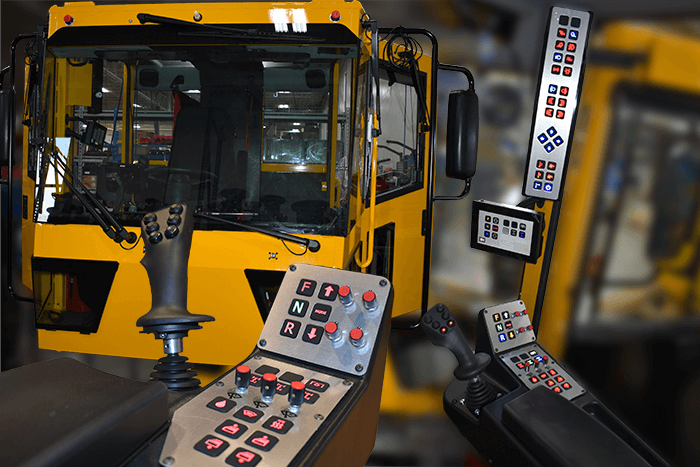
After deciding to do a full redesign of their cab, an OEM was faced with the challenge of maintaining the existing extensive functionality and ergonomics of its seat assembly, but drastically reducing the size. This client came to GS Global Resources wanting to create a more modern and aerodynamic cab design for their snow removal machine. Because of its function, the cab had a number of extra functions pertaining to the windshield glass, its wipers, mirrors and their light, and rear steering controls that needed to be easily accessed by the operator both for safety, as well as efficiency. With two entry doors, the machine’s operator also needed to be able to enter and exit the cab from either side.
Solution:
In order to maintain the large number of heated windshield and wiper controls on the seat assembly, GSGR engineers designed a custom printed circuit board with push button encoders. This allowed for highly specific control of the wiper functions. Each wiper is individually variable and programmed for 10 different known speeds, easily controlled by a rotating knob, which also has a push feature to control that wiper’s heat function. As an added safety feature, colored lights were added to the push buttons to indicate whether current state. This kept operators aware of the numerous heating functions as an added safety feature. Furthermore, if the machine is in park with both the wiper and glass heat on, the glass will automatically turn off. All of this coordination between the various heat functions was contained within those encoders built into the armrest assembly. To also give the operator convenient control over other application specific functions and attachments, we created and integrated a custom, joystick handle into the armrest assembly. This allows them to manipulate the machine’s blade, broom, and blowers, as well as the rear steering function through a dual redundant proportional trigger. So as to keep the armrest assembly size within the new design constraints, we added a separate post pillar. This acted as an extension of the armrest, in terms of control functionality, without added excess weight and area to the actual assembly.
Aside from the wide array of functions built into this assembly, we still needed to maintain optimal ergonomics for the seat assembly as a whole. So as to ensure a perfect fit for any operator, we designed the air ride seat and armrest to not only be adjustable together, able to move both horizontally and vertically, but they are also individually adjustable. Furthermore, we incorporated a U-shaped armrest pad and downward sloping joystick, creating a more natural resting position for operators and reducing fatigue. Finally, for the large number of pushbuttons on the armrest and post pillar, we used square buttons, creating a slightly larger actuation area for the operator’s control with adjustable LED lighting for feedback to the operator.
Result:
- The OEM was able to get all of the required functions in an ergonomic and efficient assembly, while still adopting the more compact, modern cab design.
- This armrest design has since been adopted and slightly adapted for multiple other OEMs looking to achieve similar goals.