
Where in the World Are Your Accumulators Going?
Accumulators are pressure vessels, so they must be certified for the country that they will be used in.
This isn’t a problem for equipment sold and used in the U.S., but what if the machine your company produces or is involved with heads overseas or you are manufacturing goods to be shipped to another country?
Date: February 11, 2019
Accumulator Certifications
Certifications for accumulators (pressure vessels) can vary depending on the application that they are used in as well as the country they are supplied to. It can become confusing and can consume an immense amount of time sorting through all the requirements and certifications required. Obtaining a correct global certification standard could be the ultimate solution, but due to parameters that must be met for individual countries and their specific regulations make this impossible to achieve
Accumulators are subject to safety laws, regulations, and ordinances that are valid in the country or the state that they will be installed in. This paper addresses the two fundamental design codes and several of the most common certifications. Many more do exist, therefore qualified engineers from the accumulator manufactures should be contacted to ensure you comply with proper conformances and standards.
Two Base Design Codes
Many countries have their own set of regulations and quality standard for hydraulic accumulators; most refer to one of two base design codes.
#1. The first code we will discuss is the oldest and most referenced design code for pressure vessels is American Society of Mechanical Engineers (ASME) which was initially written to create a standard for the manufacture of boilers on steam locomotives.
The ASME Boiler and Pressure Vessel Code Section VIII, Division 1 has evolved into requirements for pressure vessels and accumulators in the United States. This section requires the following:
- Certification on vessels with internal diameters of 6” or higher.
- Certified vessels carry the “U” symbol on them as evidence that they were designed and manufactured in accordance with the Code. The “U” symbol is an internationally recognized symbol of design and manufacturing quality.
- Accumulators must be manufactured from materials that meet ASME specifications for traceability.
- A design factor of 4:1 in the ratio of burst pressure to rated pressure. All design factors are with respect to the minimum tensile strength of the material.
- ASME requires that each vessel is marked with the design pressure at the Minimum Design Metal Temperature (MDMT) for the vessel.
- Surveillance of an approved quality system, like ISO 9001.
- All hydrostatic testing to be witnessed by an approved third party.
The 4:1 design factor requirement is mandatory for all accumulators with ASME certification except for those that comply with Appendix 22, a specific rule within the Code. Appendix 22 permits accumulators manufactured with forged shells and openings of a specified maximum size to be certified with a design factor down to 3:1 for its burst pressure to rated pressure. This primarily applies to bladder-style accumulators.
#2. The second base design code is the Pressure Equipment Directive (PED). On July 2016, PED 2014/68/EU superseded 97/23/ EC in the European Union. This directive applies to the design, manufacture, testing, and conformity assessment of pressure equipment and assemblies of pressure equipment that operates over 0.5 bar. The instructions requires the following:
- The operating fluids must be in Group 2 (non-hazardous).
- Certified vessels with a volume greater than 1 liter and a product of service pressure and volume that is greater than 50 bar-liter, or for any pressure vessel where service pressure exceeds 1,000 bar, must receive a CE mark. In general, all accumulators larger than 1 liter must be CE marked.
- Certified vessels must be manufactured from materials that meet PED specifications for traceability.
- A design factor of 2.8:1 in the ratio of burst pressure to rated pressure. All design factors are with respect to the minimum yield strength of the material.
- Certified product must pass a low-temperature Charpy impact test (temperature to be determined by application or customer).
- Surveillance of an approved quality system, such as ISO 9001.
- All hydrostatic testing to be witnessed by an approved notified body. Manufacturers can become self-certified.
- Once installed, equipment and accumulator inspection, as well as operational safety, are controlled by national laws.
Accumulators with a volume less than 1 liter, a product of service pressure less than 1,000 bar, and pressure capacity less than 50 bar-liter fall within the guidelines of PED Article 4, Paragraph 3, Sound Engineering Practice (SEP). Accumulators built to SEP must be built to a known standard and have an approved notified body to certify the design and the technical file. Since the accumulator is not held to the same levels of control, a CE does not get applied to the vessel.
Country Certifications
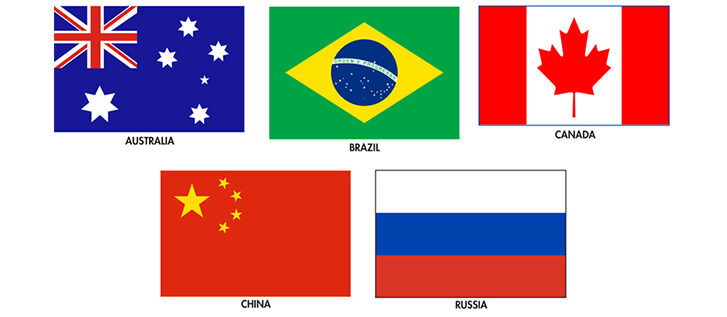
Although different accumulator manufacturers typically have approval for certifications in one or more countries, the following is a brief list of the most popular country standards that Parker’s Accumulators & Cooler Div. can provide:
Canada—Canadian Registration Numbers (CRNs) can be obtained by constructing an accumulator from ASME-certified material using ASME standards of design and then applying for the registration number. Each province has its own registration number. Thus, the end destination of the accumulator must be known. Some provinces are allowing alternative design codes like the PED for specific markets such as farming and mining. Contact Parker ACD for detailed specifics.
Australia—Pressure-vessel registration is mandatory in all Australian States and Territories. All States, except for Western Australia, have the same registration requirements. Western Australia will only accept designs that comply with pressure-equipment design codes AS 1210, ASME BPV Code Section VIII, or the British Code BS 5500 (technically now referred to as PD 5500 via the PED). All other States will accept design codes published by any recognized standards organizations.
Australian Standard AS 4343 assigns a hazard rating based on vessel size, pressure, fluid, and temperature. Hazard Ratings A, B, C, and D must have their designs registered. Australia has its own pressure-vessel design code called AS 1210. It is based on ASME design requirements. Some Australian customers may still require accumulators to this standard. Additional hydrostatic testing is required. The accumulator must be tested at 1.5 times the design pressure for 30 minutes plus an additional one minute per mm of the thickness of the shell/vessel.
China—Accumulators shipped to China require a Special Equipment Licensing Office (SELO) approval. Since October of 2014, SELO regulation (ref ECCS) is only applicable for pressure vessels are:
- Maximum working pressure is greater than 0.1 Mpa.
- Internal volume is greater than 30 liters and,
- Inner diameter is greater than 150 mm.
If a vessel does not meet these criteria, SELO is not required. If SELO is required, the pressure-vessel manufacturer must obtain a manufacturing license. In the case of piston and diaphragm accumulators, the manufacturer is the manufacturer of the complete accumulator. In the case of bladder accumulators, the “manufacturer” is the shell-component manufacturer, and the accumulator manufacturer is the “assembler.” The “assembler” does not need a license. Either ASME or PED design codes can be submitted for approval. Additionally, paperwork before and after the purchase of the accumulator is required for submittal to China for tracking purposes. All labels and nameplates must be in Chinese.
Russia—During January 2015, enforcement started pertaining to the Customs Union Technical Regulations (CUTR) for the countries of Russia, Belarus, and Kazakhstan. CUTR Declaration of Conformance must be established and joined to the pressure vessel for delivery depending on risk category. A technical passport could be required if a customer requires it. Either ASME or PED design codes can be submitted for approval, but PED is becoming more popular. A special nameplate in English and Russian languages must be applied to the vessel.
Brazil—The Regulatory Rule NR-13 establishes the minimum conditions for the installation, operation, maintenance, and inspection of pressure vessels and boilers in Brazil. Both ASME and the PED are acceptable design codes, but ASME designs are more prevalent. When NR-13 is required, Parker’s engineers can prepare a technical file for review by the Brazilian Registered Engineers (BRE). Brazil prefers their nameplates and labels to be in Portuguese. Finally, an inspection at the place of installation will be performed by the BRE. This could also include hydrostatic testing.
Industry Standards
American Bureau of Shipping (ABS) certification is required for accumulators installed on shipping vessels and oil rigs. There are many ABS maritime classifications, so be sure to have the pressure vessel certified to the correct classifications. If the pressure vessel is to be used on a drill rig, have the accumulator classified to the following: Mobile Offshore Drilling Units (Latest) & Guide for the Classification of Drilling Systems (Latest).
To be added to an ABS Product Design Assessment Certificate, accumulators must meet ASME design requirements plus additional ABS requirements. All ABS-approved accumulators must have their metal component’s Charpy impact testing witnessed by an ABS surveyor; the finished accumulator’s pressure test must also be witnessed.

Offshore Standard DNVGL-OS-E101 (formerly Det Norske Veritas & German Lloyds) often is required for accumulators on oil and gas applications, particularly in the North Sea. To obtain a Type Approval Certificate, accumulators must meet ASME or PED design requirements plus additional DNV-GL requirements. Finally, the finished accumulator’s pressure test must also be witnessed.
Typically accumulator manufacturers have approval for certifications in one or more countries. However, if you know that you are supplying a customer with an accumulator that will be used overseas, you will need to know and understand the country standards and comply.
GS Global Resources can assist you in sizing the most efficient accumulator for your application. Download the sizing form from our website and e-mail it back to us sales@gsgr.com
 Article contributed by Jeanette Cutberth, marketing coordinator for GS Global Resources
Download PDF version of the article
Resources:
Hydraulics & Pneumatics –Bill Mosher Engineering Manager Parker Hannifin’s Accumulator & Cooler Division.
American Bureau of Shipping (ABS)
ASME Boiler and Pressure Vessel Certification
DNV-GL
ECCS
Pressure Equipment Directive