
Practical Electrification Trends in Heavy Machinery
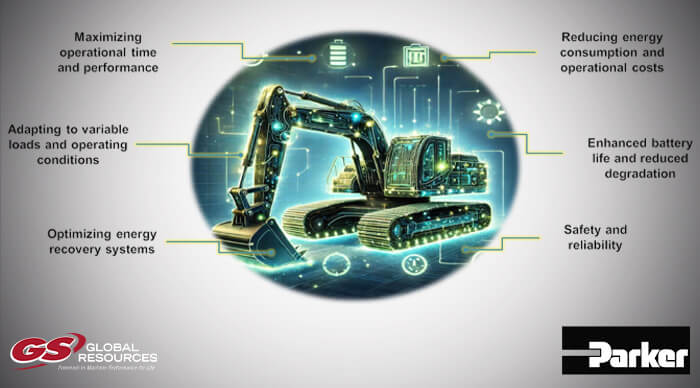
Graphic Credit: Parker Hannifin
Designing Hybrid Systems to Meet Diverse Operational Needs
Practical electrification of heavy equipment is transforming the construction and industrial machinery sectors by improving energy efficiency, reducing emissions, and lowering operational costs. As more OEMs adopt battery-electric and hybrid technologies, companies are unlocking new levels of performance and sustainability on worksites worldwide. But it’s important to remember this trend toward electrification is not yet an all or nothing game. Careful analysis of your machine and it’s individual functions is essential to integrating electric controls of batteries to best optimize energy use, while still offering a reliable, fully functional machine.
At our 2025 Innovation Summit, Chris Griffin and Craig Perry from Parker Hannifin’s Electrification Group discussed ways that OEMs can pragmatically integrate electrification into their machines, best practices to follow, and how future trends and regulations will impact OEMs taking advantage of these technologies.
Core Benefits of Electrification
“We’re witnessing a paradigm shift where quieter, cleaner, and more efficient electric machinery is enhancing operator safety and jobsite conditions.”
Electrification of heavy equipment offers numerous core benefits that make will move this from trend to industry standard over time. By integrating electric motors and other components with traditional hydraulic systems, machines that have integrated methods of electrification can achieve significantly improved energy efficiency, leading to lower fuel consumption and reduced greenhouse gas emissions. This shift ultimately results in substantial operational cost savings due to decreased maintenance needs and enhanced machine reliability. Additionally, the quieter and smoother operation of electric equipment improves operator comfort, safety, and overall jobsite conditions. Modular and hybrid electrification platforms provide manufacturers with the flexibility to adapt to evolving technology and market demands, ensuring future-proof solutions for diverse heavy equipment applications.
Phase 2 of Heavy Equipment Electrification
“Investing in modular, flexible electrification architecture allows equipment manufacturers to adapt swiftly to changing market demands and technology advancements.”
We’re entering the second phase of electrification of heavy equipment. Previously, the goal was to replace the engine with an electric motor without changing the hydraulic systems and maintain commonality with the non-electrified versions of the same machine. However, that’s proven to be too expensive and incapable of handling a full day’s energy requirement. The best way for OEMs to approach electrification now is with an optimization approach, designing systems to incorporate these electric components into the existing hydraulic system. This can include the introduction of more flow on demand elements, improving efficiency of a hydraulic circuit, or mitigating noise of the existing hydraulics. The more measured, planned approach helps mitigate the end cost, which with a completely electric machine has proven to be too expensive for the market, while still showing real ROI.
Technical and Operational Challenges
- Battery Limitations – Maximizing the operational time of a machine by accounting for all the power being out by the machine can essentially eliminate energy waste. Designing the system so that a machine adapts for variable loads and operating conditions and understanding how to reduce unnecessary energy consumption and subsequent operating costs are essential to maximizing battery life.
- Thermal Management – Because batteries heat up when in use, there must also be cooling systems or other measure to manage that heat load.
- Charging Infrastructure – While urban areas may have some charging stations available, many off highway machines work in rural or remote areas without the option of recharging during the work day.
- Energy Recovery – Regenerative systems can store unused energy generated by the system, extending battery life.
- Complex Software – By integrating additional components into the machine’s control system, simply put, it’s more complex in terms of programming.
Future Trends and Regulations
“Battery technology advancements are the key enablers making electric equipment viable for rigorous, round-the-clock industrial applications.”
While full electrification of heavy machinery is still a long-term goal, hybrid systems will likely act as a bridge in the near term due to both technology and cost limitations. There is now significant market acceptance of EV technology, operators and end customers sustainability goals, and creating a certain brand and company image. However, sustainability regulations, while still moving forward in some markets, are being delayed in others. In China, there is significant inertia in on and off-road sectors with central government support of infrastructure and conversion with rebates and subsidies. In Europe, there are a lot of mandated on-road emissions and noise targets, urban area restrictions for heavy equipment, and incentives like EV tolling. In the USA, many regulations and requirements have been led by California, but many of those are being paused or delayed by a few years.
Future innovations in energy recovery, thermal management, and alternative power sources such as hydrogen will further accelerate this industry shift. But currently, pragmatic electrification is a real way for OEMs to reduce operating costs, enhances jobsite safety, operator comfort, and machine reliability, paving the way for a cleaner and more productive off highway and industrial machinery sector.
Want to learn more? Contact us to take a more in-depth look at practical opportunities for electrification and how they can be applied to your machine.